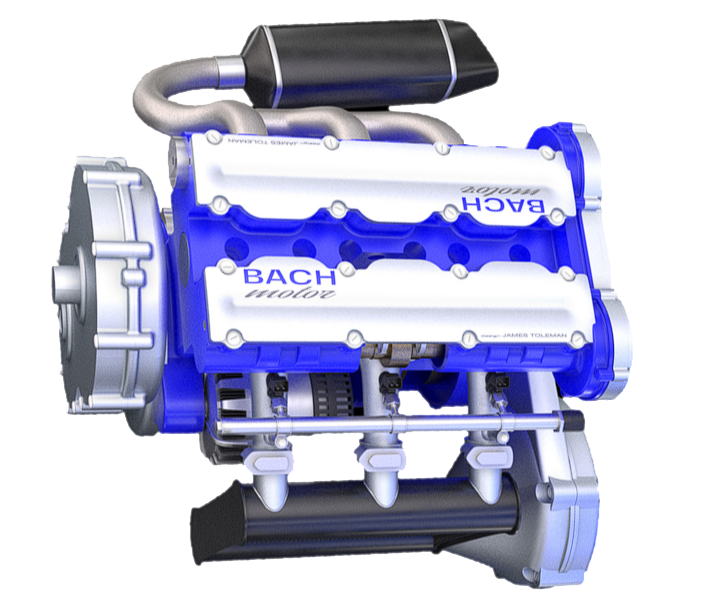
Efficiency, cost, and performance for applications under 800 kW.
Context
Spark-ignition piston engines (or gasoline engines) and gas turbines have different advantages and
disadvantages depending on the application. Here are some of the advantages of spark-ignition
engines over gas turbines.
Key advantages
1Better efficiency at part load due to their ability to change their airflow and air-fuel ratio
depending on load, which is not the case for gas turbines. Which they are more efficient at
maximum load.
2Lower cost of acquisition, use and maintenance.
3For well-established technical reasons, below 800 KW, a modern piston engine, designed
specifically for aeronautics, will be more efficient than a turbine. The evolution of the compression
rates of the smallest of them shows their lower limit.
Further points
A piston engine turns slower than a gas turbine, which has a consequence for the size of a reduction
gear or an alternator.
The infrared signature and noise of a piston engine are advantageous compared to that of a turbine.
When powered, the piston engine is less sensitive to altitude.
The choice between a gasoline engine and a gas turbine depends on the specific application and
performance requirements.
Technical comparison
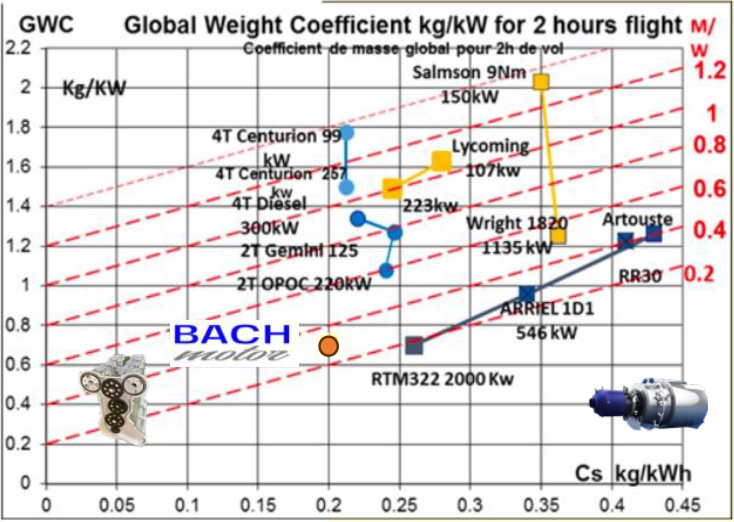
This chart expresses the mass (engine + fuel) that must be taken into account for a 3-hour mission and per kW produced. It allows you to compare different engines. Source: Bernard CERTAIN study
The weight of a Turbine, the sobriety of a Diesel, the performance of a Gasoline engine.